
Microbiological findings and antimicrobial susceptibility in emergency abdominal surgery
Published 2020-04-28
How to Cite
Abstract
Introduction: It is important to maintain bacterial surveillance programs to decrease resistance and define adequate pharmacological schemes. Patients with abdomen represent a special microbiological group.
Objetives: Make a review of pathogens in adult patients operated in our Emergency Service for abdominal pathology with free fluid and analyze the results obtained from cultures with respect to the strains and susceptibility to antibiotics.
Materials and Method: Prospective cohort study with descriptive statistics. We include consecutive patients, older than 18 years old, operated on by abdomen who present free intraperitoneal fluid between November 2017 and April 2018. Cases with antimicrobial therapy, hospitalization and/or surgery 3 months prior are excluded. Positive cultures, isolated strains, antimicrobial susceptibility, demographic data and clinical evolution are recorded.
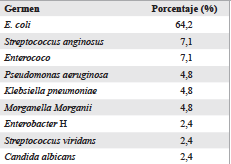
Results: Of 63 patients, 55% were men and the average age was 52.2 years. The most frequent pathologies were of appendicular origin (62%) and of enteric origin (30%). In 44% the crop was positive and in 36% with more than one germ. Escherichia coli was the most frequent pathogen (64.2%) followed by Enterococcus faecium and Streptococcus anginosus (7.1%). Of the others, cultivated pathogens have only observed multiple resistance in an isolated case of Morganella Morganii.
Conclusions: These data include the local microbiological reality in acute abdomen. Escherichia coli is still the most frequent germ that must be faced with the profile and the appropriate treatment. It is necessary to maintain local microbiology surveillance for a proper management.